SERAFINA / AN INTRODUCTION
Serafina Dávalos
A life dedicated to opening possibilities.
A lawyer, educator, and a voice in Paraguayan feminist thought. Encountering Serafina means returning to questions of education, autonomy, and equality.
Biographical journey · documentary sources
40 milestones in a life, viewed through documents and questions still unanswered.
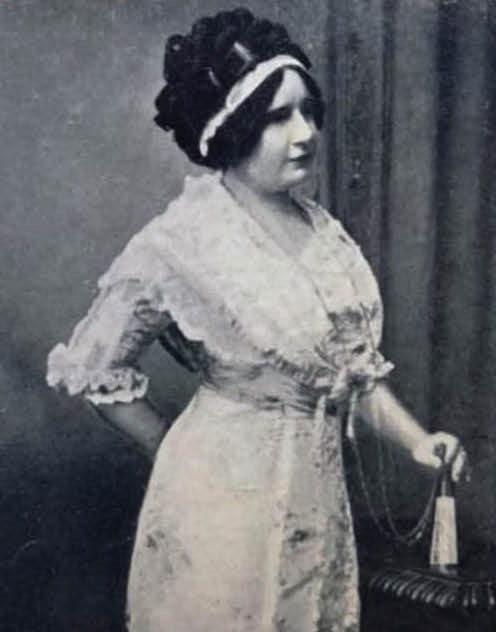
Attribution to verify
visual map
One life, eight turning points
A quick reading of the great displacements of the biography. Open dates also remain open in the display.
life map · 01
Origins
For decades, biographies of Serafina repeated 1883 as her year of birth. A birth record located by Rosemary Dávalos and published by MUPA instead records 9 September 1877 in Ajos (now Coronel Oviedo). This biography uses 1877 as the documented date; 1883 is retained only to explain how the earlier attribution was transmitted.
Document exhibit
The document
The birth record is shown in full so readers can examine the document directly.
9 Sep 1877Documentary object
Birth record · 1877
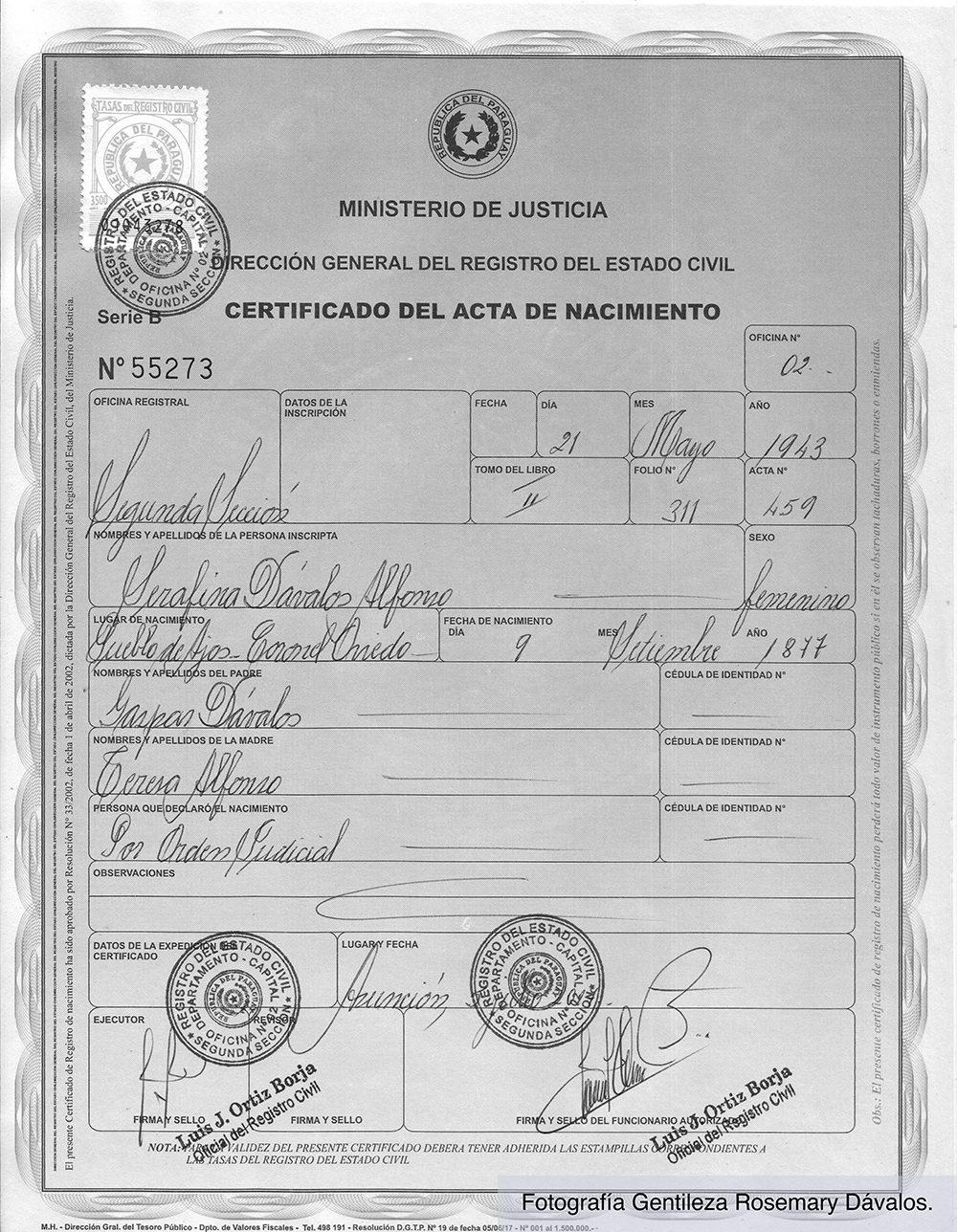
MUPA · reproduction of the record located by Rosemary Dávalos
Canonical sourceSRC-058
life map · 02
Learning, teaching, taking the floor
By the late 1890s, Serafina was already taking part in public life, not merely attending classes. A newspaper account from 1898 identifies her as a student at both the Escuela Normal and the Colegio Nacional and reports that she had been chosen to address the president. The press praised her intellectual abilities and envisaged higher education for her at a time when such paths remained exceptional for women.
In 1903, Serafina brought her education into public debate. Her lecture El feminismo, organised by the Society of Law Students and later published in the La Plata journal Nosotras, openly challenged inequality. In that same text, she said she was working to establish a commercial school for girls. Her writing, legal education and educational initiatives thus formed part of a single developing career.
Student and public speaker before the President (1898)
The facsimile chronicle of El Pueblo (April 19, 1898) reports Serafina as a student at the Normal School and simultaneously at the National College, chosen to speak before the President, and praises her speech and her intellect, also proposing possible future doctorates in medicine or in law and social sciences.
Feminism: 1903 conference and publication in Nosotras
The conference Feminism was announced in La Democracia (Aug 19, 1903) and was held under the patronage of the Society of Law Students before a large and select audience, with few women; The text was serialized in Nosotras (La Plata), numbers 46, 47 and 49 of November and December 1903.
Declared work to found the Mercantile College (1903)
In Feminism (1903) Serafina Dávalos declares that she had been working for some time to found a Mercantile School for girls. The text accredits its authorship and founding intention, not the opening date of the establishment.
Document exhibit
Press and portrait
Three documentary traces illuminate different moments in Serafina's life: her public reception in 1898, a newspaper portrait published in Buenos Aires in 1908 and a reproduction of her 1943 identity document. The catalogue distinguishes the historical originals from the modern reproductions through which we know them.
TEACHER-TRAINING GRADUATION
Another milestone, three years later.
The documents distinguish Serafina's 1895 cohort in the preceptors' course from her graduation in 1898 among the first women to complete teacher training. Showing both dates keeps two stages of her education distinct.
Apr 18/19, 1898Record without facsimile
The People · public reception of a speech
El Pueblo presents Serafina as a student at the Normal School and, at the same time, at the National School; The chronicle praises her speech and her intellectual ability. The 2025 edition retains an internal discrepancy: an editorial note indicates April 18, while the header associated with the facsimile identifies April 19. The site keeps that difference visible instead of turning it into a closed date.
El Pueblo, April 1898 · facsimile reproduced in the Arandurã 2025 edition
Canonical sourceSRC-020
February 22, 1908Record without facsimile
PBT 171 · Distinguished guests
PBT magazine published a portrait of Serafina during her stay in Buenos Aires. The project preserves the reproduction included in the 2025 Arandurã edition; the original PBT page remains an acquisition target. The comparative statements in the note are treated as press attributions from 1908, not established facts.
PBT no. 171, February 22, 1908 · reproduction in Arandurã 2025 edition, p. 120
Canonical sourceSRC-020
Nov 1943Record without facsimile
Identity card · portrait from 1943
The 2025 edition reproduces a portrait on Serafina's identity card with the legend November 1943. The corpus documents this reproduction, but it still does not preserve the original identity record or sufficient documentary context to reconstruct the complete record.
Portrait of identity card · reproduction in the Arandurã 2025 edition
Canonical sourceSRC-020
life map · 03
Colegio Mercantil: an institution in motion
The Girls' Mercantile College was a sustained undertaking, not a minor episode in Serafina's life. Sources differ on whether it was founded or opened in 1904 or 1905, but contemporary records show that it was operating by 1905: an advertisement names Serafina as director, sets a monthly fee and offers free tuition to students unable to pay. A 1906 payroll identifies staff, salaries and Honoria Balirán as a teacher and secretary.
A letter signed by Serafina in 1907 provides even more insight into the project: it describes free education, dependence on state subsidies, and a new plan drawn up after studying models of commercial schools in Belgium, France, the United States, and Argentina. The school continued to relate to the State, obtained an academic incorporation into the National School in 1910, continued active in 1915–1916 and is still listed under its direction in January 1921, before the reorganization documented that same year.
Open question
Foundation and opening of the Mercantile College: 1904 versus 1905
Sources give different dates: MBO'E 2019 records the founding in 1904 and the compiler of the 2025 edition claims opening in March 1904, while other histories fix 1905; the contemporary announcement from 1905 credits public operation that year. The distinction between initiation, opening and formal recognition remains open.
Mercantile College advertised in 1905 with Serafina as Director
The periodical Tribuna de los intereses del Paraguay (1905) advertised the Colegio Mercantil de Niñas, identified Serafina Dávalos as its director and stated a monthly fee of 30 pesos in national currency. The notice also included the wording «Gratis para los pobres» (“Free for the poor”). The first issue of the volume is dated 3 March 1905; the advertisement is evidence of the school being publicised, not a formal appointment of its director.
Return of July 1906: Serafina's address and Honoria's positions
The monthly expense report for July 1906 (National Archive, PY ANA SE-MJ-456-1-106) credits Serafina Dávalos as Director of the Girls' Mercantile School and documents Honoria Balirán in two paid positions: second-year grammar teacher and secretary. This is an institutional fact.
Letter signed to the Ministry: increase in subsidy and new plan (1907)
Serafina Dávalos, as Director of the Girls' Mercantile College, signs a letter dated February 8, 1907 that requests an increase in the monthly subsidy from 3,500 to 5,500 pesos as of March 1, declares that education is free and that the state subsidy is her only source of resources, and argues that she studied commercial schools in Belgium, France, the United States, and Argentina before formulating the new plan.
Decree of 1910: study plan and incorporation into the National School
The Official Registry of 1910 records the request made by the Director of the Girls' Mercantile School to modify the study plan and the decree of August 6, 1910 that approved it, ordered exams to be taken according to the new plan and described the school as "incorporated into the National School of the Capital." This is an academic and administrative incorporation, not extinction or merger of the institution.
Mercantile College: continuity and scale, 1915–1916
Official messages and publications from 1915–1916 show the Mercantile Girls' School in activity and maintain Serafina Dávalos as director.
Licenses and retirement of the national teaching profession in 1920
Three decrees from 1920 document licenses and then the retirement of Serafina Dávalos as an educator for the national teaching profession.
Mercantile College: continuity in January and refusion in April 1921
The Ministry still addresses Serafina as director of the Girls' Mercantile College on January 26 and 27; On April 1, the presidential message describes the refusion of the Girls' Mercantile School into the School of Commerce.
Document exhibit
The Colegio in the documents
File sheets showing how the Girls' Mercantile College was administratively registered. They are presented as documents, not as illustrations of everyday life.
1906Documentary object
Form of the Girls' Mercantile College
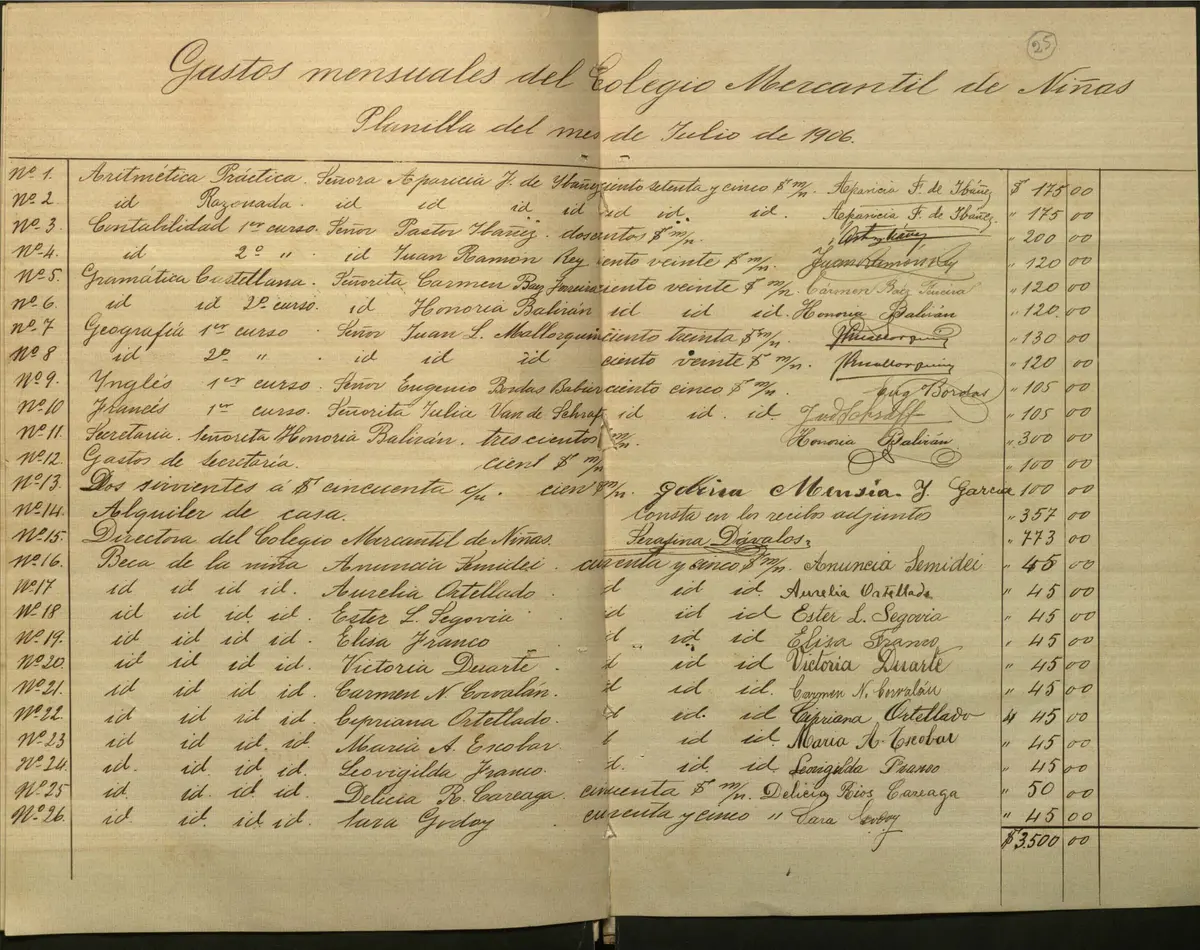
National Archive of Paraguay · school forms, July 1906
Canonical sourceSRC-008
1910Documentary object
Curriculum of the Mercantile College
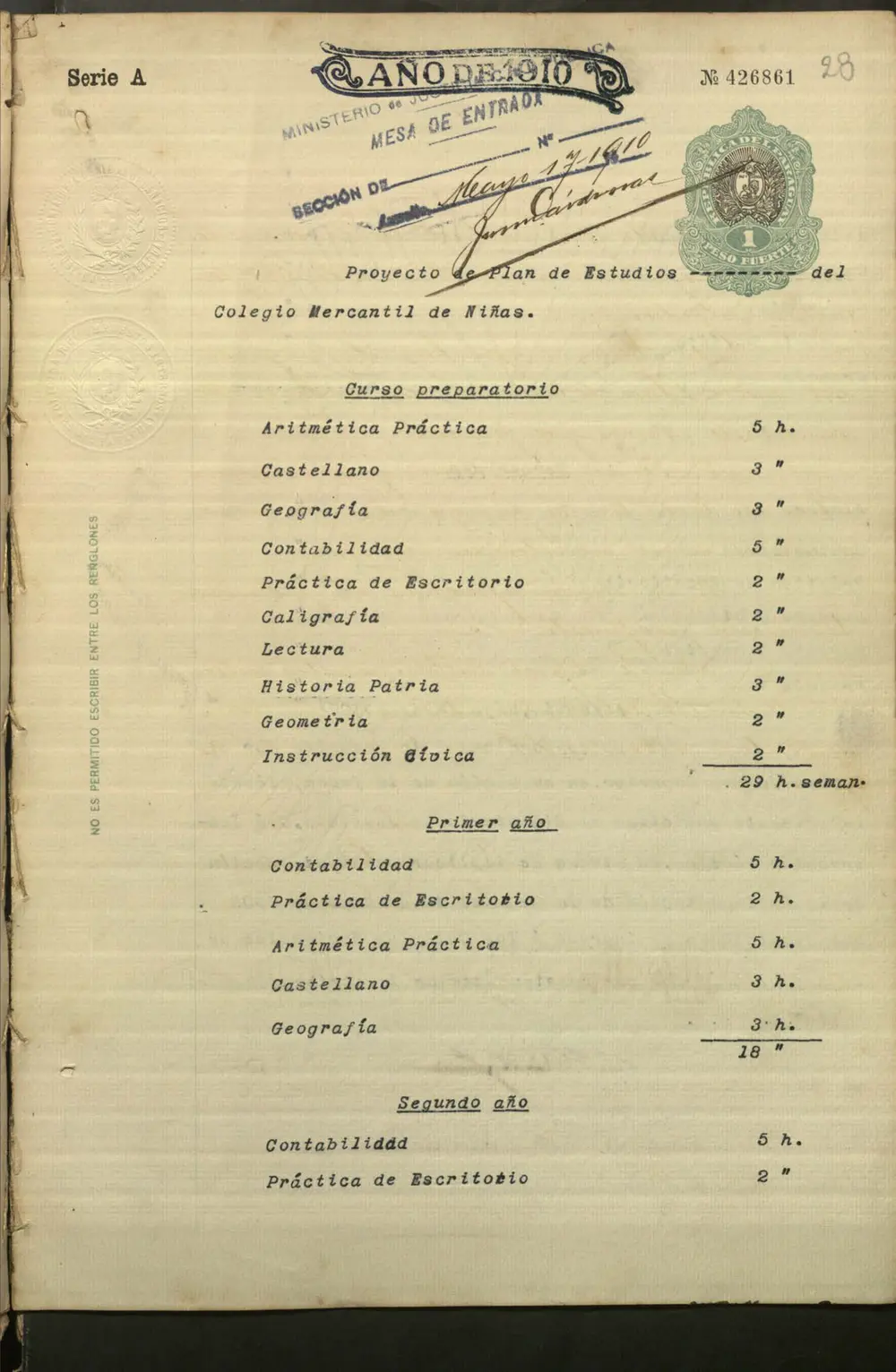
National Archive of Paraguay · official plan of the Mercantile College, 1910
Canonical sourceSRC-010
life map · 04
Humanismo, law and a public voice
1907 concentrates several dimensions of Serafina's career. That year she published Humanismo and completed her legal training, although the sources do not allow the entire chronology of the degree to be reduced to a single date. The thesis is not only a university requirement: it discusses the subordination of women from biology, law, the Constitution and social organization, and converts arguments that were already circulating in its public voice into a much broader program.
Her professional career can also be traced through contemporary documents. In 1908 she was appointed to the National Council of Education. Speaking before the International Women's Congress in 1910, she said that she was practising law independently and reported that Paraguayan jurists had put her name forward for the Superior Tribunal; it has not been established, however, that she ever held that post. Court records and professional directories document her presence in legal practice until the mid-1920s.
Humanism: thesis published in 1907
Humanismo (1907), Serafina Dávalos's thesis, is preserved with facsimiles of its cover and frontispiece. Its chapter headings include «La Mujer como ser biológico» (“Woman as a Biological Being”), «La esclavitud de la Mujer no es natural» (“The Enslavement of Women Is Not Natural”), «La Mujer ante el Derecho» (“Women Before the Law”) and «La Mujer paraguaya ante la Constitución Nacional» (“Paraguayan Women and the National Constitution”). In the work, she describes herself as «Catedrática en el Colegio Nacional» (“teacher at the National College”).
Open question
Chronology of the Law degree: 1901/1902 and 1907 in conflict
A biographical appendix associated with Humanismo dates Serafina's baccalaureate to November 1901. Parker, by contrast, gives 1902 for her baccalaureate and 1907 for her doctorate. The doctoral chronology remains unsettled: Berino uses the phrase «laureada de doctora» in connection with 8 July 1907; Humanismo bears an author's date of September 1907; and another account gives 17 September 1907 for the defence. Records from 1903 also disagree between «2.º curso» and «3er curso de Derecho». These different dates and course descriptions should not be combined into a single confirmed timeline.
Appointment to the National Education Council
A decree published in the 1908 Registro Oficial (p. 409) names Dr Serafina Dávalos, together with Eligio Ayala, Ignacio A. Pane and Andrés Gubetich, as members of the National Council of Education. The council had been declared without a functioning membership after all its members resigned or ceased to serve; a further decree records the acceptance of a resignation on 13 October 1908.
International Women's Congress of 1910: delegation, presidency, debate and closing
Serafina Dávalos participated as a Paraguayan delegate in the First International Women's Congress, was a member of the Propaganda Commission in America and was appointed to chair the Law section. She presided over the session on May 21 at the Presidente Roca School, put the proposal for absolute divorce up for discussion, and on May 24 she gave the closing speech and formally declared the congress closed. In that speech she defended the full personality of women, co-education, access to public employment, active and passive suffrage and equal pay.
Free practice of law and proposal for the Superior Court (1910)
In her closing address on 24 May 1910, Serafina stated: «ejerzo libremente mi profesión de abogada» (“I practise freely as a lawyer”). This is direct evidence that she was practising law in 1910. She also said that several jurists, including Cecilio Báez, had proposed her for a position on the Superior Tribunal. The proposal is attested, but there is no evidence she ever held that post.
Documented legal practice, 1909–1925
A procedural action from 1909, a professional directory from 1915 and a contemporary assessment from 1925 allow us to document the presence of Serafina Dávalos in the Paraguayan forum.
Document exhibit
Humanismo, biography and law
A work, a first-person statement, a biography close to its time and judicial records: documentary objects that accompany the chapter without replacing the reading of the sources.
1907Record without facsimile
Humanismo
The work is recorded from the secondary reference of Rocco Carbone: the date of 1907 and the thesis character come from that study. The site does not include the complete facsimile.
Reference edition 2007 · CDE / Kuna Roga (master in the corpus of work)
Canonical sourceSRC-001
May 24, 1910Record without facsimile
First-person legal practice
In the closing speech of May 24, 1910, Serafina affirms in the first person that she freely exercises her profession as a lawyer. It is direct evidence of professional practice in 1910; does not in itself demonstrate an uninterrupted practice until 1957.
First International Women's Congress · closing speech, May 24, 1910
Canonical sourceSRC-003
1921Documentary object
Paraguayans of Today · biographical entry, pp. 187–188
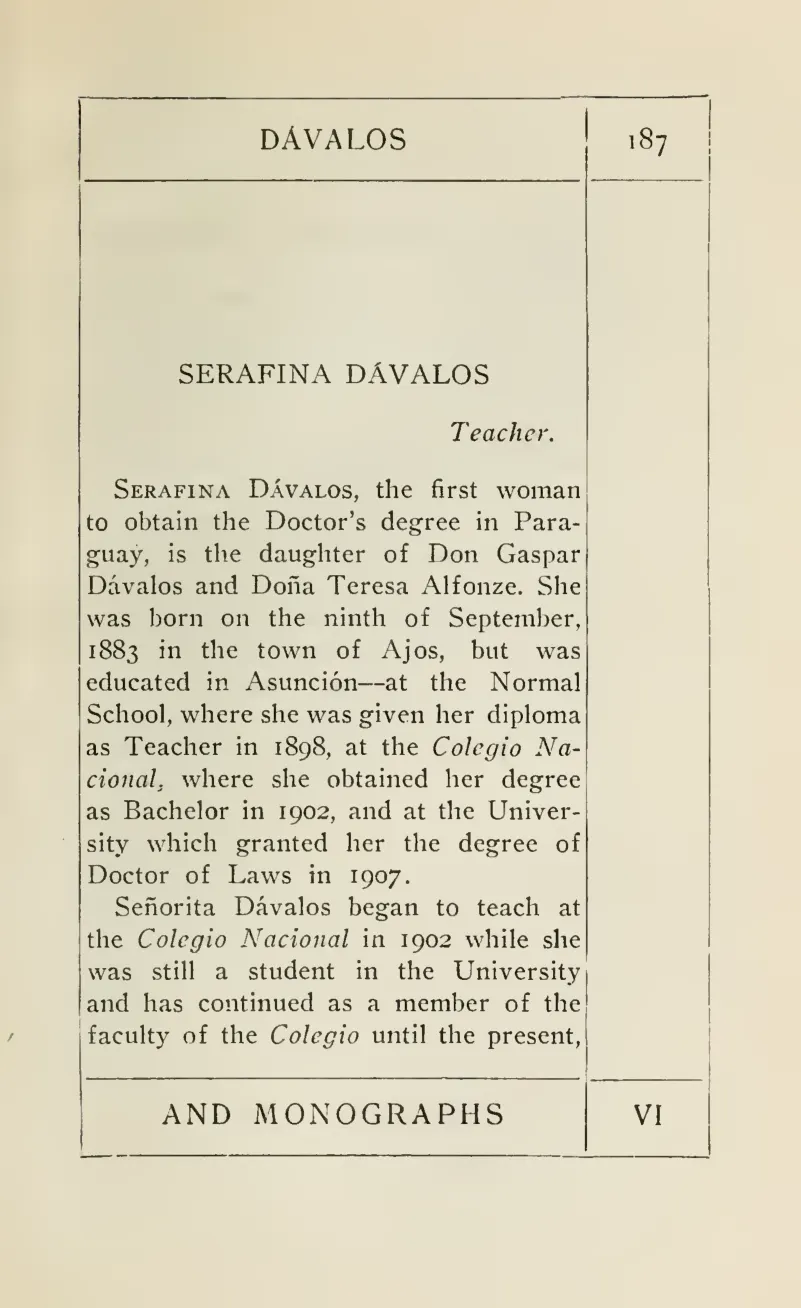
Canonical sourceSRC-045
1921Documentary object
Paraguayans of Today · p. 188
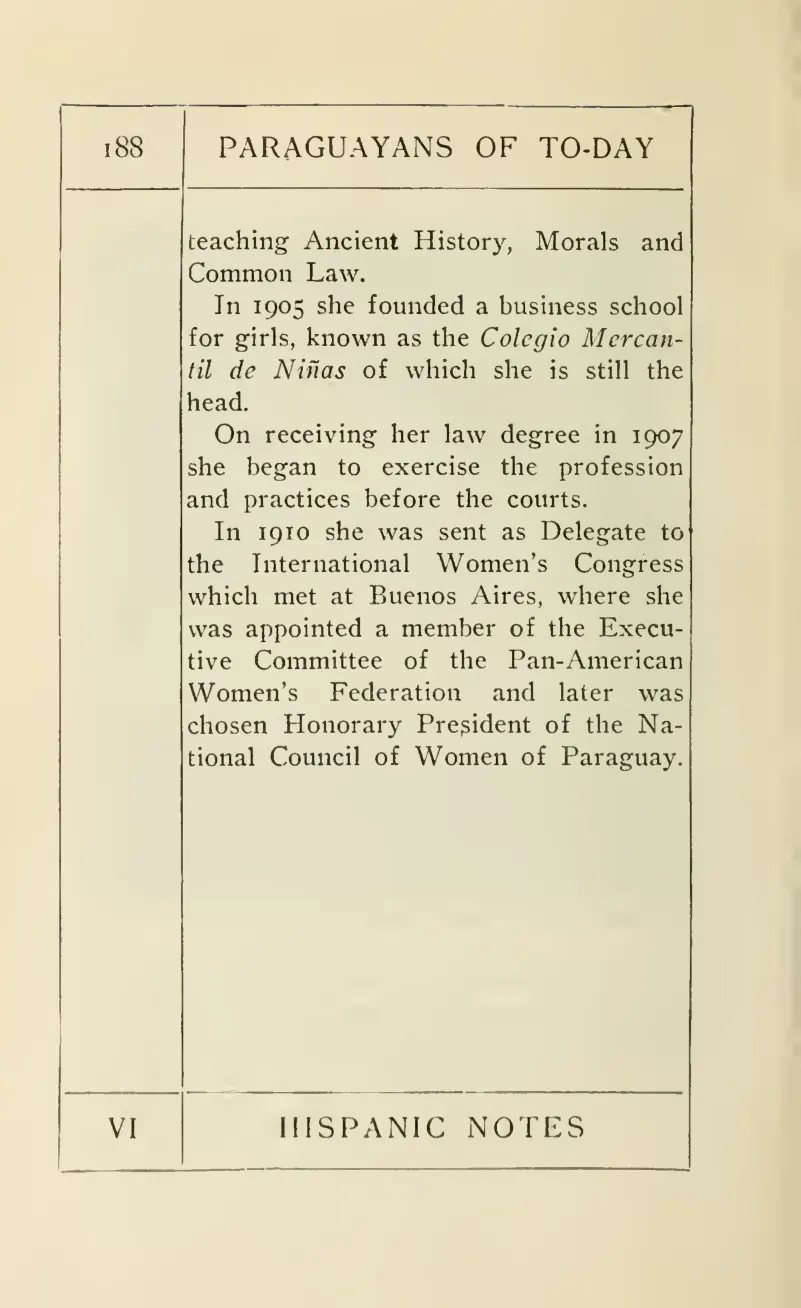
Canonical sourceSRC-045
1920Documentary object
Bulletin of the Courts · well-proven argument
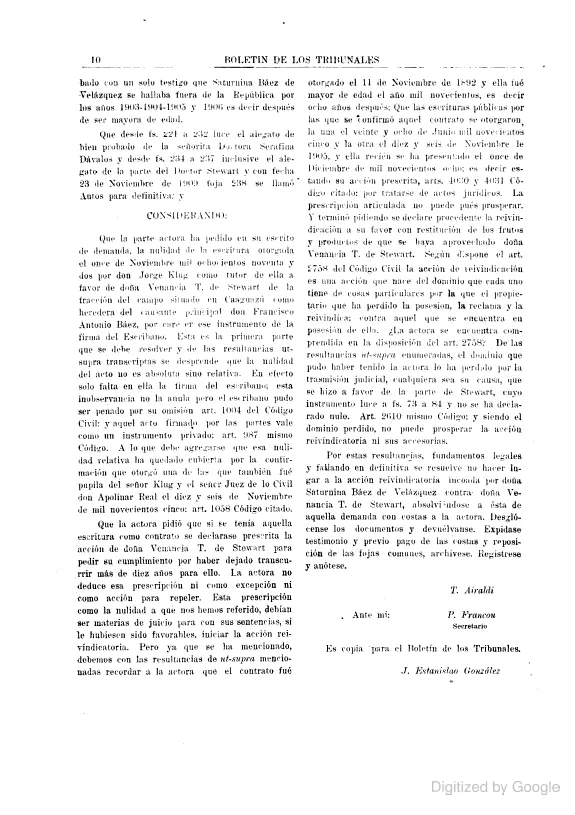
Bulletin of the Courts, 1920 · Google Books
Canonical sourceSRC-069
life map · 05
American networks and feminist organizing
Serafina's participation in reform networks and women's organizations did not end with the 1910 congress. In 1916 she appeared as secretary of the Paraguayan National Committee for the First American Children's Congress; In 1920 she appears linked to the statutes commission of the Paraguayan Feminist Center; In 1936, the Paraguayan Women's Union elected her councilor.
In the 1950s, Serafina appeared again in records of the Paraguayan League for Women's Rights: sources identify her as a council member and later honorary president. Accounts differ on her precise role in the League's founding in 1951, so this biography does not label her a founder without documentary support. What is clear is the continuity of her influence: successive generations of women's rights organisations continued to recognise her as an active figure.
First American Children's Congress: secretary of the National Committee of Paraguay
The 5th Bulletin of the First American Children's Congress identifies Serafina Dávalos as secretary of the National Committee of Paraguay. The data places it within the Paraguayan structure that articulated national participation in a continental meeting dedicated to children and shows an institutional dimension of its public activity beyond teaching, law and the Commercial College. The document, however, only allows us to affirm the position of secretary: it does not in itself prove that she attended the congress or performed other functions.
Paraguayan Feminist Center: statutes commission
A report published in 1936 reconstructs the formation of the Paraguayan Feminist Center in 1920 and places Serafina Dávalos among those who made up its statutes commission. The mention is important because it links it not only with discourses on women's rights, but with the work of organization and elaboration of internal rules of a feminist entity. The source is retrospective: sixteen years elapsed between the episode and the publication, a temporal distance that the project explicitly preserves.
Women's Union of Paraguay: elected councilor
On August 28, 1936, the press of the Paraguayan Women's Union itself registered Dr. Serafina Dávalos as a councilor elected in the second assembly of the organization. The data shows that her participation in spaces organized for women's rights continued to be documented decades after her interventions at the beginning of the century and places her in a deliberative function within another female institution. The project exactly preserves the published position and does not extrapolate from it executive functions that the source does not mention.
Paraguayan League for Women's Rights: roles in the fifties
Between 1951 and 1957, different evidence places Serafina linked to the Paraguayan League for Women's Rights: she appears as an advisor in subsequent reconstructions of the founding context, as a documented advisor since 1952 and as honorary president since 1956. The sequence shows continuity of her presence and recognition within the organized movement in the last years of her life. Sources, however, disagree about her exact role in the 1951 founding; That is why the site does not present her as a founder without the act or a primary founding list.
life map · 06
House, Honoria and mature life
Serafina's private life is one of the areas where the archive requires more caution. The institutional documentation places Honoria Balirán alongside her as early as 1906, as a professor and secretary of the Mercantile College. Decades later, testimonies and retrospective memories used expressions such as private secretary, inseparable companion or life partner. These formulas are preserved attributed to their sources: they are not transformed into a self-definition that Serafina and Honoria did not leave documented.
The house allows us to follow another material history. The official heritage assessment places its construction in 1914, although a contract, original plan, permit and contemporary architectural authorship are still missing. The domain records prove that Honoria was the owner of Property 3,335 before January 1957, that the State purchased the property that month and that in 1963 it was registered in favor of the IPS. The link that explains how and when Honoria acquired the property is still missing.
The construction of Casa Serafina dates back to 1914.
The historical assessment of the National Secretariat of Culture places the construction order of the house associated with Serafina Dávalos in 1914.
The house: a proven chain of ownership and a still unknown link
The ownership documentation proves that Honoria was already the owner of Finca 3,335 before January 1957; The State bought it from Honoria on January 23, 1957 and the property was registered in favor of the IPS on August 28, 1963.
life map · 07
1957: death, the case, and open questions
Serafina died on September 27, 1957. Reconstructing her last months, however, requires carefully separating registry documents, memories and subsequent accusations. The sale of the house to the State in January 1957 is documented; Other stories about residences, money and property appear later and do not have the same evidentiary weight.
Press reports from 1957–1959 identify Case No. 154/1957 and preserve testimony, accusations and a public defence concerning Honoria Balirán and Serafina's final years. Neither the original case file nor its judicial outcome has yet been recovered. This account therefore distinguishes documented facts from allegations and does not claim to know how the case ended.
Death of Serafina Dávalos
Serafina Dávalos died on September 27, 1957. The date functions as a secure anchor of the project's chronology and is corroborated by different historical reconstructions and documentary controls of the corpus, which also preserves an organizational obituary from 1957 and family memories about her last days. From here begins a posthumous dossier that is much more difficult to reconstruct. Locating the civil death certificate remains a pending final primary-source check; that absence does not cast doubt on the date used.
Open question
Last residence and assets: registry facts versus conflicting stories
At the beginning of 1957 there is a firm registry fact: the ownership documentation shows that Honoria Balirán was already the owner of Property 3,335 and that the State purchased the property on January 23. Later accounts about where Serafina lived after that sale, other properties, her financing, and the financial circumstances of her final months appear in the 1959 complaint and in later memoirs. The site keeps these two levels of evidence separate: deeds and the chain of title on one side, allegations and recollections on the other, until new primary documents are found.
life map · 08
A memory that continues to shape the present
Serafina's memory moved beyond the pages of history books. Since the mid-2000s, her name has appeared in feminist cultural spaces such as La Serafina. Between 2019 and 2024, new biographies, comics and theatrical works retold her life for different audiences. These varied forms show how a historical figure can acquire new meanings without diminishing the need to return to the sources.
In 2026, memory also acquired a specific heritage and institutional dimension: Law 7679 created a national commission to restore and enhance the Serafina Dávalos House and provides for the property to function as a memory center for women's struggles and rights. The subsequent installation of a work table opened a new stage, but it is not yet equivalent to a completed restoration. The legacy, in that sense, continues to occur in the present tense.
La Serafina: the name of Serafina converted into a feminist cultural space
Aireana adopted the name La Serafina for its cultural space in explicit homage to Serafina Dávalos; The organization places the project in operation since 2005 and explains this choice in the 2007 edition of Humanismo.
Books, comics, children's biography and theater: new forms of public memory
Between 2019 and 2024, Serafina's legacy circulated in new biographies, comic strips, and theatrical works documented by editorial records, press, and official sources.
Law 7679/2026 and the beginning of public governance to restore the Casa Serafina
Law 7679 created the National Commission for the restoration and enhancement of the Serafina Dávalos House and ordered that, once restored, it function as a memory center for women's struggles and rights. On August 6, 2026, the Senate documented the installation of an interinstitutional working group to initiate actions.